.png?width=400&height=115&name=KBRW-logo-400x115%20(1).png)

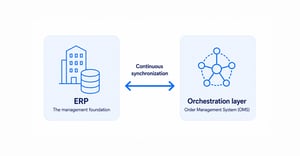
ERP remains the backbone of enterprise information systems. It centralizes financial processes, procurement and part of operational management. Yet today's supply chains require far more than transactional processing. As omnichannel commerce, continuous disruption and increasingly complex fulfillment networks become the norm, organizations need an architecture capable of orchestrating operations in real time without replacing their core enterprise systems.
This is why more companies are evolving their architecture by combining ERP with an Order Management System. The objective is not to replace ERP, but to extend it with a dedicated orchestration layer focused on operational execution. This complementary approach improves customer experience, increases operational agility and prepares organizations for next-generation capabilities, including AI-driven decision making.
In this article, you'll discover why ERP is reaching its limits for real-time operations, what capabilities an OMS adds, and why combining both solutions is becoming the new standard for complex supply chains.
ERP vs. OMS: What's the Difference?
Enterprise Resource Planning (ERP)
An ERP centralizes core business processes including finance, accounting, procurement, manufacturing and master data management. It serves as the enterprise's transactional system of record, ensuring data consistency and governance.
Order Management System (OMS)
An OMS orchestrates the entire order lifecycle and execution processes. It makes real-time decisions regarding inventory availability, delivery promises, order allocation, returns and omnichannel fulfillment.
Why Is ERP Alone No Longer Enough?
For decades, ERP systems formed the core of enterprise operations. They successfully centralized finance, procurement, inventory management and accounting within a single platform. This model worked well when supply chains were relatively predictable and sales channels were limited.
Today's environment is fundamentally different. Geopolitical uncertainty, regulatory changes, climate events and volatile demand require organizations to adapt continuously. According to KPMG, 73% of supply chain executives expect to transform their operating model within the next three years to improve agility and resilience.
Customer expectations have evolved just as dramatically. Whether in B2B or B2C, customers expect real-time inventory visibility, reliable delivery promises within seconds and seamless experiences across every channel.
These new requirements expose the limitations of traditional ERP platforms. Designed primarily for transaction processing and data consistency, many ERP systems still rely on batch processing and highly customized architectures. As new operational requirements emerge, organizations often respond by adding custom developments, increasing technical debt and making future upgrades more complex.
The answer, however, is not to replace ERP. It is to restore ERP to its original role while complementing it with specialized solutions built for real-time, high-performance operational execution.
What Capabilities Does an OMS Add?
An Order Management System addresses precisely these new operational requirements. Its purpose is to orchestrate the entire order lifecycle while continuously making real-time decisions based on the latest operational data.
An OMS manages execution processes that require speed, real-time visibility and continuous adaptability.
| Business Need | How an OMS responds |
| Reliable customer promises | Recalculates product availability in real time using available inventory, projected inventory, existing orders and logistics constraints, delivering far more accurate delivery commitments. |
| Operational continuity | Continues orchestrating orders even during ERP maintenance or downtime, ensuring uninterrupted business operations. |
| Reduced technical debt | Operational logic evolves within the OMS instead of being embedded in ERP customizations, simplifying upgrades and accelerating SaaS migration initiatives. |
| Process automation | Automates matching between orders, payments and invoices, allowing customer service and finance teams to focus on exceptions rather than manual reconciliation. |
| Omnichannel execution | Orchestrates orders, inventory, returns and allocation across channels, warehouses, stores and logistics partners to ensure consistent execution. |
| AI readiness | Provides an API-first architecture and real-time operational data foundation required for advanced AI use cases across the supply chain. |
Why Is Combining ERP and OMS the Best Approach for Real-Time Supply Chains?
Positioning ERP and OMS as competing solutions no longer reflects today's reality. They serve different purposes and naturally complement one another.
ERP remains the trusted system of record for finance, compliance and master data. It provides the governance, traceability and transactional robustness required by large enterprises. OMS, meanwhile, orchestrates operational execution, automates business decisions and ensures continuous execution even in highly dynamic, complex environments. This separation of responsibilities decouples the management of physical flows from financial processes, allowing each system to focus on what it does best.
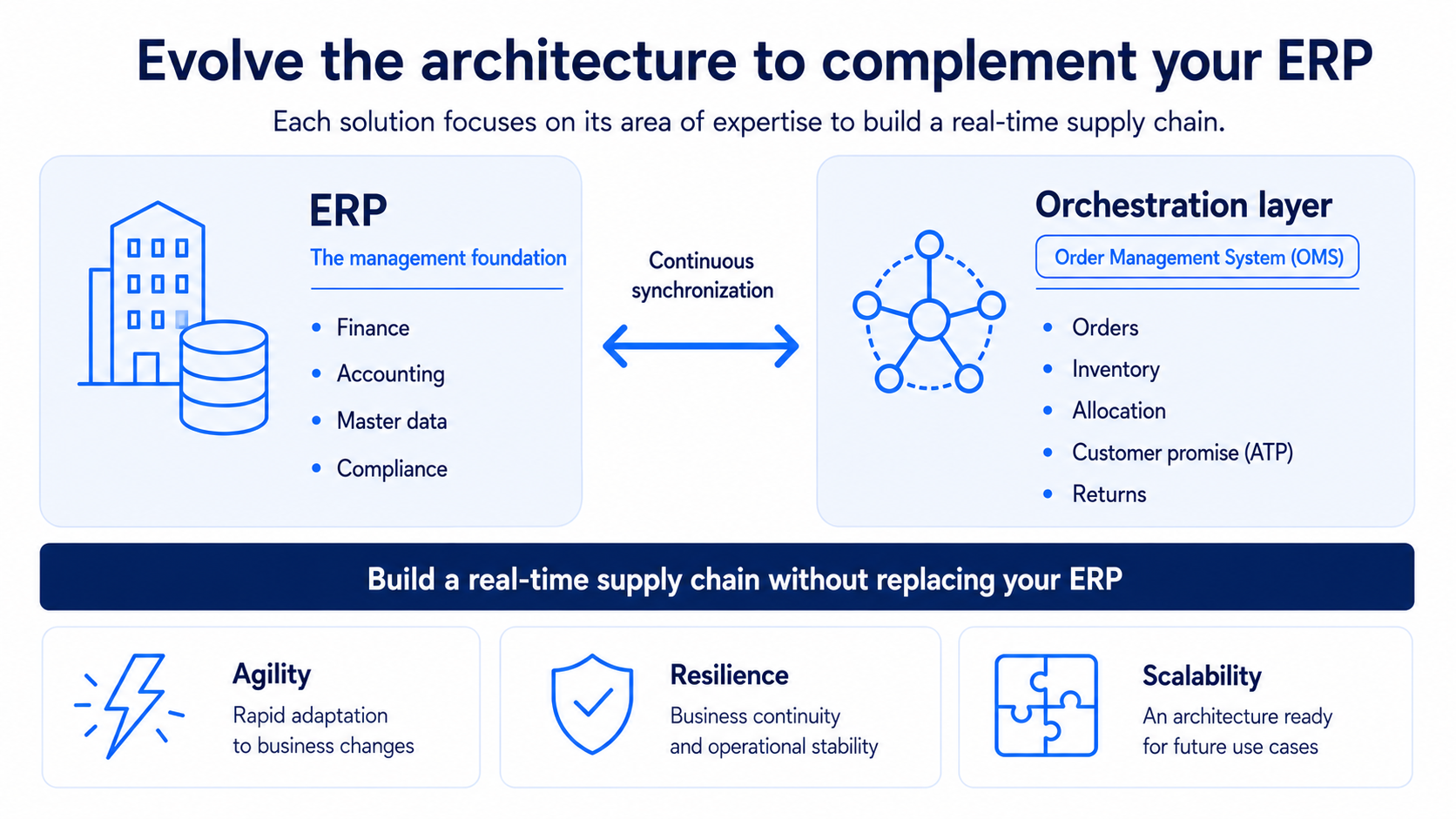
The benefits are significant. Organizations improve SLA performance through more reliable delivery promises and real-time execution adaptability. They reduce technical debt, accelerate modernization programs and simplify SaaS migration initiatives while strengthening overall business resilience.
For large enterprises, the challenge is no longer selecting a single application. It is designing an architecture capable of evolving with the business, integrating new services rapidly and supporting long-term growth. In this context, combining ERP and OMS has emerged as one of the most effective architectural approaches for balancing financial governance with operational excellence.
Conclusion
According to Gartner, only 29% of supply chain organizations currently possess the capabilities needed to address future challenges. Among the highest priorities for leading organizations are real-time visibility and data analytics, both of which have become essential for building agility in an increasingly uncertain environment.
This shift confirms that supply chain performance now depends as much on real-time decision-making as on robust business processes. Building a real-time supply chain is no longer about choosing between ERP and OMS. Leading organizations combine both, allowing each platform to focus on its area of expertise.
Within this architecture, ERP remains the foundation for financial processes and master data management, while OMS provides the real-time orchestration and execution capabilities required to meet customer expectations and respond to supply chain disruptions. Together, they improve customer experience, enhance operational performance, reduce technical debt and accelerate digital transformation.
Discover how the Kbrw Order Management System complements your ERP to build a more agile, resilient and future-ready supply chain.